↓ Skip to main content

Blog

Various thoughts and advertisements! Posts before 29 August 2026 are an archived copy of public Facebook posts. Comments? Email me.

A Model of Errors for LLMs

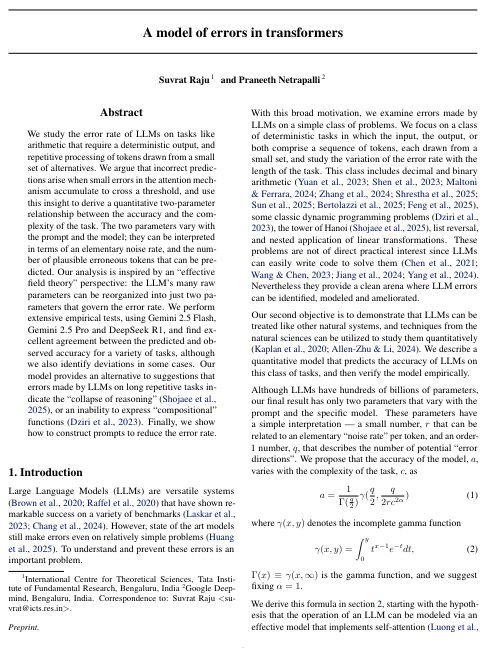
Here is something different, with Praneeth Netrapalli.

https://arxiv.org/abs/2601.14175

LLMs have made spectacular progress over the past few years. Yet they still make errors on relatively simple tasks and we don’t have a good understanding of why these errors arise. This is reflective of a broader problem that should bug all theorists: our scientific understanding of these systems greatly lags the technology.

This paper examines these errors in a very simple setting — the ability of the model to implement deterministic tasks like arithmetic, list reversal etc.

Even state of the art LLMs are poor at these tasks. It is hard to see this from the web interface because the models have been trained to invoke external tools like Python when they encounter these tasks. So if one asks ChatGPT to implement a long multiplication, it returns the right answer by invoking an infinite-precision tool behind the scenes, even though the model itself doesn’t have the ability to perform the task natively. Because models can be taught to use these tools, their weakness at tasks like arithmetic is not a question of direct practical interest. But it is still of scientific interest because these tasks offer a controlled set of problems where one can set up and verify theoretical models.

We theorize that LLMs make errors because “noise” in the “attention mechanism” accumulates to cross a threshold. This leads to a quantitative prediction for the relationship between the expected accuracy and the length of the task. (For those who are interested, the prediction is that the accuracy, a, and the complexity c are related via: $a=\gamma(q/2, q/(2 r c^2))/\Gamma(q/2)$, where q,r are two parameters with a simple interpretation that depend on the prompt and the model and \gamma is the lower incomplete gamma function. )

Our derivation is inspired by the philosophy of “effective field theory.” The LLM itself has hundreds of billions of raw parameters. But by thinking about it the right way, one can argue that these parameters reorganize themselves into two effective parameters q,r.

Of course, this is not a rigorous EFT analysis of the kind that we have in physics let alone the kind of theorem that computer scientists might want. But its still very nice that a clear set of assumptions and arguments lead to a simple two-parameter effective model.

We validate this formula using 200,000 prompts across many different tasks and three state-of-the-art models. It works surprisingly well. But, interestingly, it doesn’t always work and when it doesn’t work, it teaches us something about the functioning of the model.

There has been a fair amount of previous work on this question. One set of papers suggested that the failure of models on tasks like arithmetic and dynamic programming indicates a fundamental limitation in its expressive power to implement “compositional” functions. And last year, a paper from Apple suggested that these failures indicated a “collapse of reasoning.” But our diagnosis is different — and we have a quantitative model that fits the empirical data nicely not just when a = 0 and a = 1 but all the way in between.

P.S: One contribution that we definitely make to the ML literature is to add the notion of error bars! (I haven’t yet read an ML paper that has error bars on its empirical graphs. ๐Ÿ˜…)

The Debate over Israel's Suspension from the IOAA

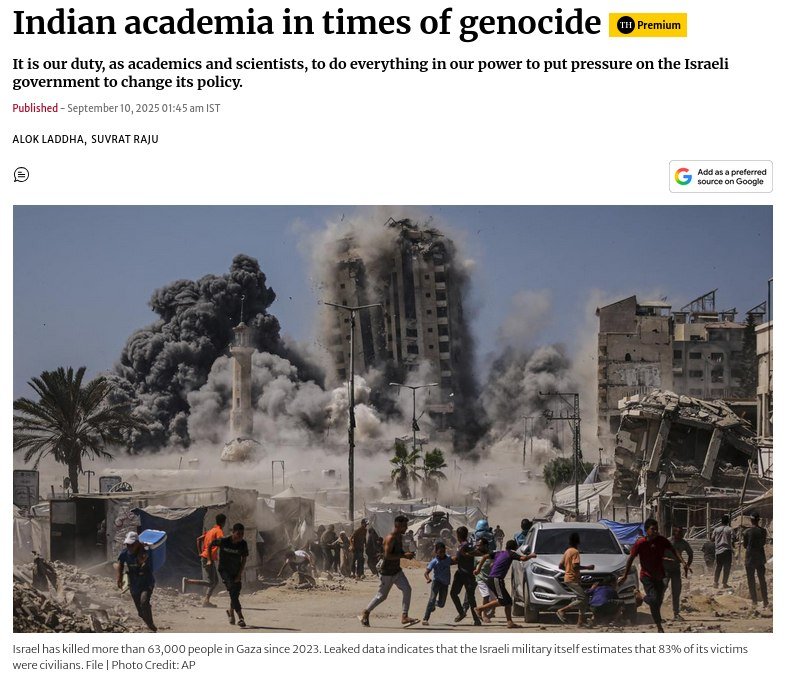
There has been debate on the suspension of Israel from the IOAA. Alok and I wrote this oped for the Hindu today, which can be read here: https://drive.google.com/file/d/1RjqaVpzwJliMJexl5iRK-pVv1qSZlfQJ/view?usp=sharing

I would also recommend the article by Madhu and Aditi in the Scroll that appeared a few days ago: https://scroll.in/article/1086205/why-we-signed-a-petition-asking-for-israel-to-be-suspended-from-from-the-astronomy-olympiad

There is a news article here: https://www.thehindu.com/sci-tech/science/rift-among-indian-scientists-as-international-olympiad-on-astronomy-and-astrophysics-bans-israel-from-future-editions/article70009127.ece

and also a post here: https://sciencechronicle.in/2025/08/31/ioaa-statement-clears-the-air-on-israels-suspension-from-future-astronomy-olympiad-events/

I’m happy to have more discussion, but I request that you read all the articles above before commenting.

Israel Suspended from the IOAA

Updated 20 August 2025

Israel has been suspended from the International Olympiad on Astrononomy and Astrophysics (IOAA). The IOAA is part of a network of science Olympiads that seek to identify the most talented high-school students in each country.

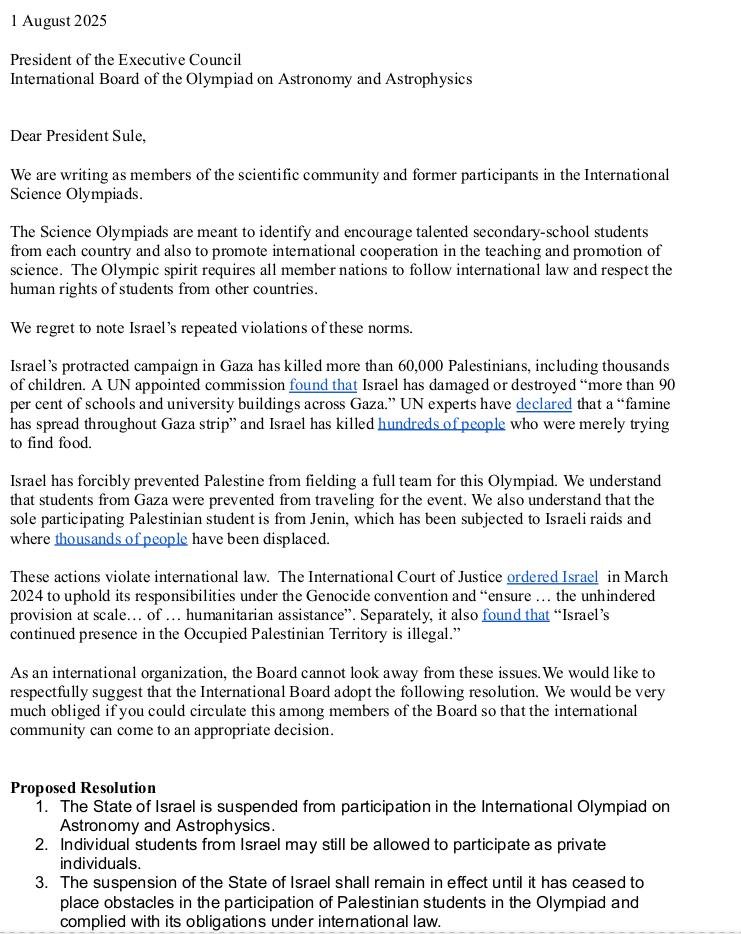
This year the IOAA was held in Mumbai. Israel had pre-registered for the event although, eventually, it did not send a team. Members of the Indian and international scientific community sent the letter below to the IOAA requesting it to suspend the State of Israel, while allowing students from Israel to participate as individuals.

The initial signatories of the letter were Alok Laddha, Suvrat Raju, Ronak Soni, Sandip Trivedi, Ravinder Banyal, Ashoke Sen, Nissim Kanekar, Ahmed Abbes and Pierre Vanhove. In all, more than 500 academics signed the letter.

The IOAA board, comprising representatives from 64 countries discussed this proposal on 18 August. While the issue was not relevant for this year due to Israel’s absence, a significant majority of the board voted to suspend Israel from future Olympiads while allowing individual students to participate.

We greatly appreciate Prof. Aniket Sule, the president of the IOAA for his integrity and commitment to democratic values in placing our letter before the international board for an open discussion and vote.

This sets a significant and important precedent: countries that are guilty of genocide and practice apartheid are not welcome to send official representatives to international scientific and cultural events. Individuals from those countries can participate but not as official representatives of their governments.

I hope that, from next year, the other science Olympiads and even the Olympic games follow this precedent.

Of course this is only a small step in the larger scheme. But to whatever small extent, I hope this conveys the horror and disgust with which the rest of the world views Israeli policies in Palestine and encourages the Israeli government to change course immediately.

Summer School with Scientists for Palestine

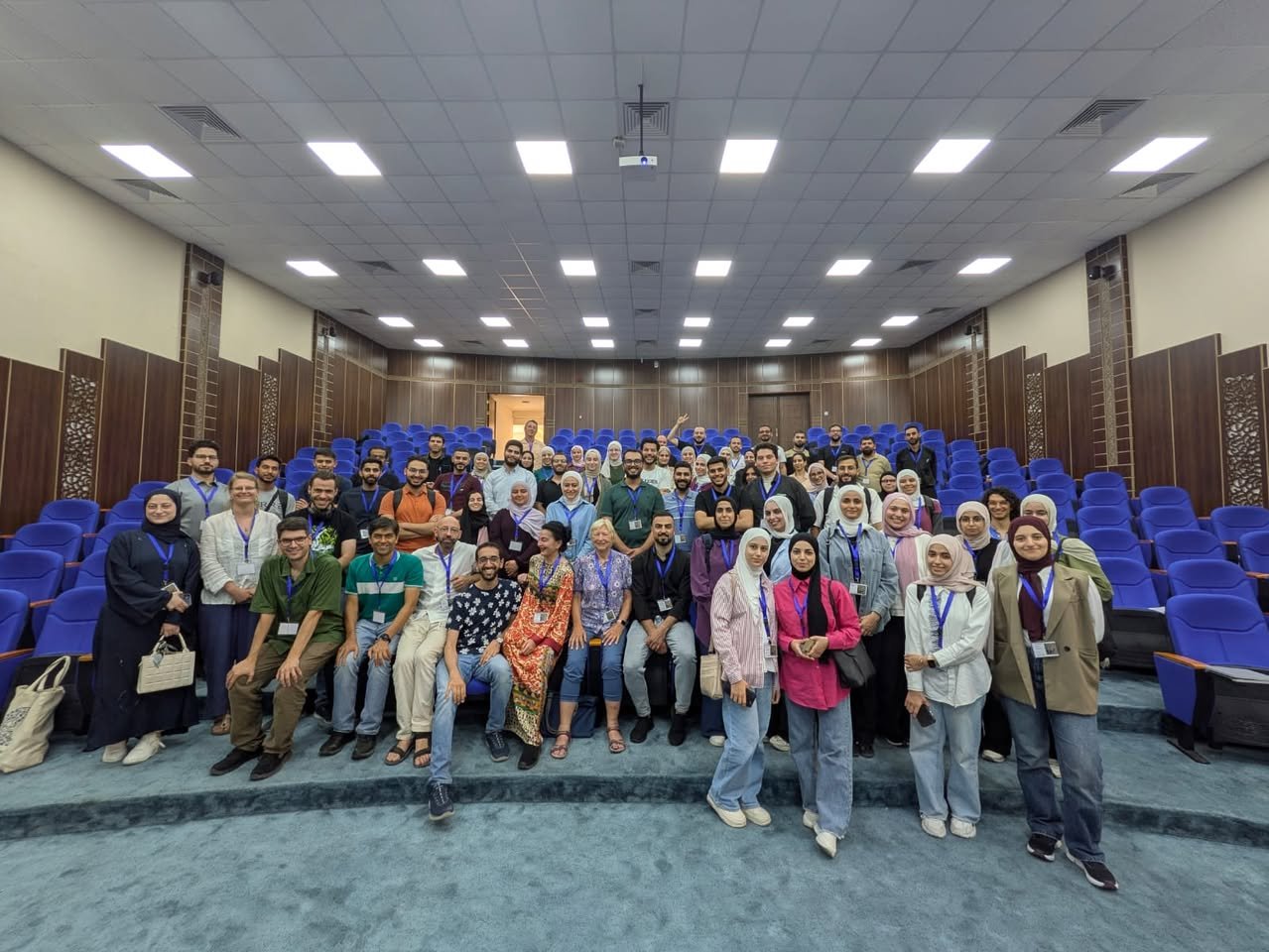
Very privileged to have attended the Advanced Summer School on Quantum Physics organized by Scientists for Palestine. I learned a lot from the courageous and generous Palestinian students who attended the event despite everything that is happening. Many thanks to Scientists for Palestine for organizing this.

Indiaโ€“Pakistan Academics Dialogue

Please join us for an interaction between academics from India and Pakistan on Thursday evening. See below for details and Zoom link. This meeting is open to everyone.

๐ˆ๐ง๐๐ข๐š-๐๐š๐ค๐ข๐ฌ๐ญ๐š๐ง ๐š๐œ๐š๐๐ž๐ฆ๐ข๐œ๐ฌ ๐๐ข๐š๐ฅ๐จ๐ ๐ฎ๐ž

When nations are at war, nationalism dominates the narrative and exercising freedom of speech may be misconstrued as treason. In the prevailing atmosphere of jingoism and warmongering, how should academic scholars conduct themselves and advance the causes of peace and justice?

Join Zoom Meeting

https://us06web.zoom.us/j/86579487198?pwd=gvWIpW1FEE37StIbHKeYFDlamSH4f9.1

Date and day: 12 June, Thursday

Time: 7:30 pm, Pakistan time, 8 pm, India time

Chair: Prof. Pervez Hoodbhoy, Physics, Pakistan

Speakers: Mridula Mukherjee, History, India A.H. Nayyar, Physics, Pakistan Achin Vanaik, Political Science, International Relations, India Syed Jaffar Ahmed, Social Sciences, Pakistan Aditya Mukherjee, History, India Sadia Manzoor, Physics, Pakistan Radha Kumar, Peace and Conflict Resolution, India Riaz Ahmad, Chemistry, Pakistan Amit Singh, Mechanical Engineering, India Riaz Shaikh, Social Sciences, Pakistan

Moderator: Suvrat Raju, Physics, India

Discussion on the UGC Draft Regulations

Academics for Democratic Rights (https://acdr.in/) and India Academic Freedom Network (https://www.indiaacademicfreedom.net/) are organizing a virtual discussion on the UGC Draft Regulations tomorrow: Sunday, 6 April at 3 pm.

The discussion will be led by Dr. Furqan Qamar, Dr. Sudhanshu Bhushan and Dr. P. K. Abdul Rahiman.

If you would like to attend, please register at this link: https://docs.google.com/forms/d/1QhY0ie3gjPyhIXw-SMUTsGJL9eqNIKX4uG6Bpi4WZ8c/edit

(Alternately scan the QR code in the poster below)

Academic Freedom at Harvard

I am surprised at how rapidly elite U.S. Universities have crumbled under pressure from the Trump administration and are cracking down on pro-Palestinian activism.

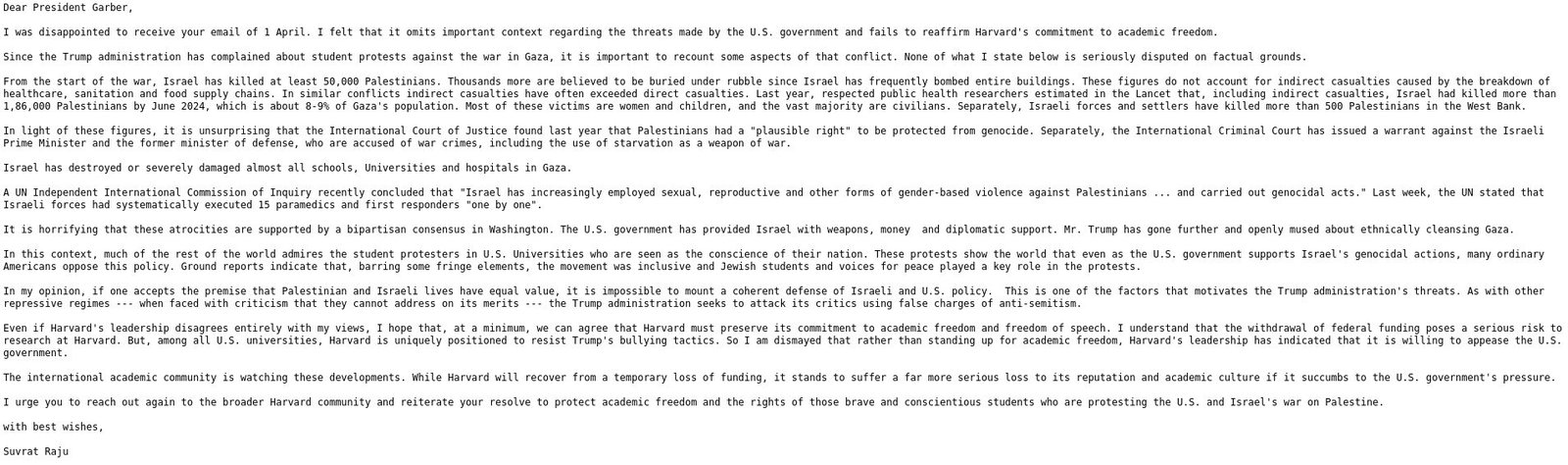
Here is an email I sent to Harvard’s president today in response to an email sent by Harvard’s leadership to all alumni signalling that it is willing to appease the Trump administration.

A second point I find disturbing is that while some academics have been willing to raise the rather obvious concerns about academic freedom, very few are willing to make the other obvious point: the student protesters are taking a brave and morally correct stand by opposing Israel’s genocide in Gaza. The Trump administration is simply responding like other repressive regimes do: faced with criticism that it cannot address on the merits, it chooses to attack its critics by inventing false charges of anti-semitism.