↓ Skip to main content

Blog

Various thoughts and advertisements! Posts before 29 August 2026 are an archived copy of public Facebook posts. Comments? Email me.

Are Page curves relevant for real Black Holes?

Vasudev Shyam got Geoff Penington and me to be part of a podcast discussion today morning. We discussed whether islands and the Page curve are relevant for realistic black holes.

As Geoff pointed out at the end, it is good to broaden and democratize these discussions as much as possible, so you can see for yourself: https://www.youtube.com/watch?v=ZCIho8geEfI

The video itself is pretty long so here is, I believe, a reasonable summary of what we agreed and disagreed on:

We agree that information is always outside the black hole for a physical observer. Therefore, in a standard theory of gravity, information doesn’t “emerge” the way that Page argued that it does. I feel that this suggests that deriving a Page curve is not crucial for understanding the information problem. Geoff’s disagrees with this perspective.

We agree that it is possible to find a Page curve if one looks for it. One possibility is to modify the theory by coupling it to a nongravitational bath. In these theories the graviton is massive and information does emerge according to a Page curve.

Alternately, we agree that it is also possible to simply disallow the observer outside the black hole from measuring the components of the metric that correspond to the energy. Such an observer sees a Page curve even in standard gravity.

My perspective was that this Page curve reflects our voluntary choice of disregarding some information that is available at all times. Geoff argued that this was physically natural.


What does `same place' mean over time?

Updated 22 January 2024

Since I spend some of my time thinking about how to localize observations in gravity, I couldn’t help thinking about this question today.

How do we decide that a structure we build today is at the same spatial location as another event that supposedly happened a few thousand years ago?

If we stick to a geocentric perspective, one possibility is to use some local reference frame like rivers or mountains. But these tend to shift quite considerably over the course of a few thousand years.

And why should we localize something just on the crust of the Earth, which is so small compared to the Earth as a whole? But if we broaden our perspective, we now have the problem that the continental plates drift by a couple of centimetres a year. This itself would give us a few tens of metres of drift over a few thousand years, which might be larger than the size of the structure we are building.

Moreover, we are taught to think from a Universal perspective in India. And some of these questions supposedly pertain to the Lord of the Universe. From that perspective, the Earth itself is rather small even within the solar system and our galaxy, let alone the Universe. The galaxies and stars themselves have moved quite a lot in a few thousand years. So, if one were to use a different coordinate system, the “spatial point” where something happened a few thousand years ago might now not lie within the Earth at all or even within the Earth’s orbital trajectory.

From the flags outside our house, I infer that many people around me seem to understand this very well, and so I must be missing something basic. Nevertheless, I can’t help being somewhat puzzled. Any answers?

A Candlelight Call for Palestine in Bengaluru

Updated 30 October 2023

The Karnataka government continues its appalling policy of preventing any public events in solidarity with Palestine. In Bengaluru, police shows up at venues before organizers do and even film screenings have been stopped.

So citizens groups are calling for people to light a candle, hold a poster and upload pictures publicly tomorrow (31 October from 6:30 pm.)

Please participate and SHARE this widely.

Karnataka's Ban on Pro-Palestine Protests

Updated 28 October 2023

The Karnataka government has clamped down completely on protests for Palestine. In any case, in Bengaluru, space for protests is sharply restricted and protests are allowed only in Freedom park. For those who haven’t been there, this is a completely-out-of-the-way enclave, which ensures that no one sees the protest. (Worse, in my opinion, than Azad Maidan in Mumbai or Jantar Mantar in Delhi). But the government has refused to allow protests on Palestine even at Freedom park. A week ago, members of the Left parties intimated the police and staged a protest, only to be promptly detained. This follows an FIR that the police lodged against those who attended an event on 16 October in MG Road.

For almost 10 days, Bengaluru for Justice and Peace (a group that I have been part of) has tried to get permission for a protest. Some members of the group met the chief minister. Others met the police commissioner (after waiting for hours), and then the DCP in charge of freedom park. The police has denied permission each time.

This is completely unconstitutional. And clearly the police is simply implementing a decision that has been made by the state government. (Doesn’t take much to figure out what their political calculations are.)

Oppenheimer, Hiroshima, and the Use of the Atomic Bomb

Today is Hiroshima day. I was troubled by the discourse around “Oppenheimer” as we approached this anniversary. Here is my dissenting take on the movie.

The movie glosses over the fact that, during the second world war, Oppenheimer did not restrict himself to the technical aspects of the bomb. He advocated for its use in Japan, dismissed other options, and played a role in planning its delivery so that it would take as many lives as possible.

Most seriously, by glorifying the Manhattan project and the US victory in the technical race to build the bomb, the movie obscures the magnitude of the crime committed by the Truman administration when it decided to bomb Hiroshima and Nagasaki.

The article provides more details.

https://thewire.in/film/oppenheimer-did-not-stop-at-building-a-nuclear-bomb-he-also-pushed-for-its-use-in-japan

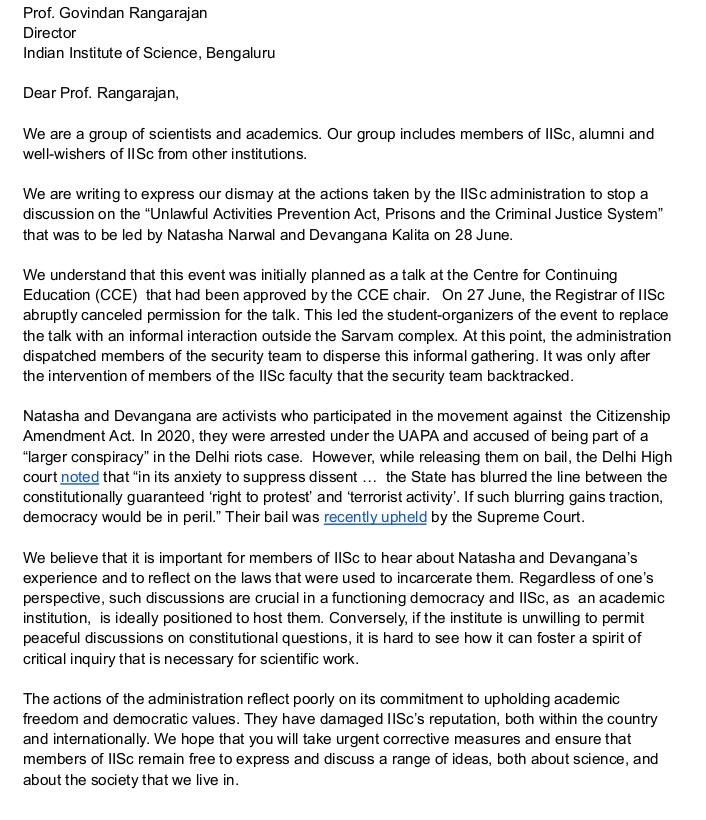
Academics Protest IISc's Cancellation of the UAPA Discussion